

US data centre power demand rising 10x faster than grid capacity, accelerating a switch to alternatives, Howden research finds
 Prefer us on Google


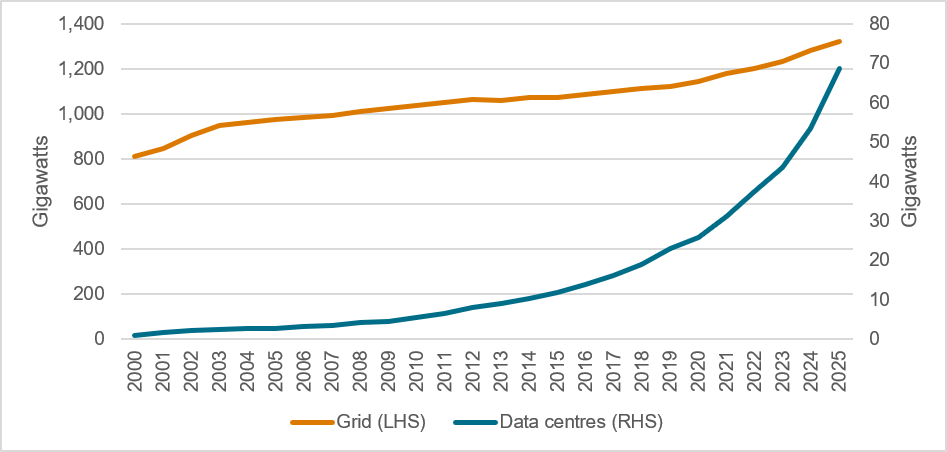
- US data centres have increased their power demand by 19% per year since 2000, 10x faster than the 2% annual capacity expansion for the electricity grid.
- Power constraints are adding 24-72 months to data centre build times, leading to lost revenue of up to US$2.4 billion, according to Howden estimates.
- To avoid increasing grid strain, data centres will need to generate 58% of their power demand from alternative sources by 2030.
London and Miami, 11 November 2026 – Howden, the global insurance broker, today highlighted new research accompanying its latest report, ‘Insuring the data centre supercycle’. New analysis reveals how growing demand for artificial intelligence (AI) infrastructure is exposing much older underinvestment in the grid networks required to move power to where surging demand sits. This is driving a capex boom in the utility sector and concurrently accelerating a shift towards alternative power sources for data centres, bringing new operational and financial risks. The research finds that US data centre power demand has risen by 19% per year since 2000, while the US electricity grid has expanded capacity by just 2% per year over the same period. As a result, data centres' share of total US grid capacity has grown 50-fold, from 0.1% in 2000 to 5% in 2025.
Read our data centres report
Figure 1: Power consumed by US data centres vs grid capacity
(Source: Howden analysis of EIA data and 451 Research by S&P Global)
At the same time, power limitations are adding 24-72 months to build times to the most constrained data centre construction projects. Across the data centres tracked by Howden, annual revenues approach US$400 million at the top end, implying a cost of US$800 million to US$2.4 billion in lost revenue alone for the largest, most power-constrained data centre builds.
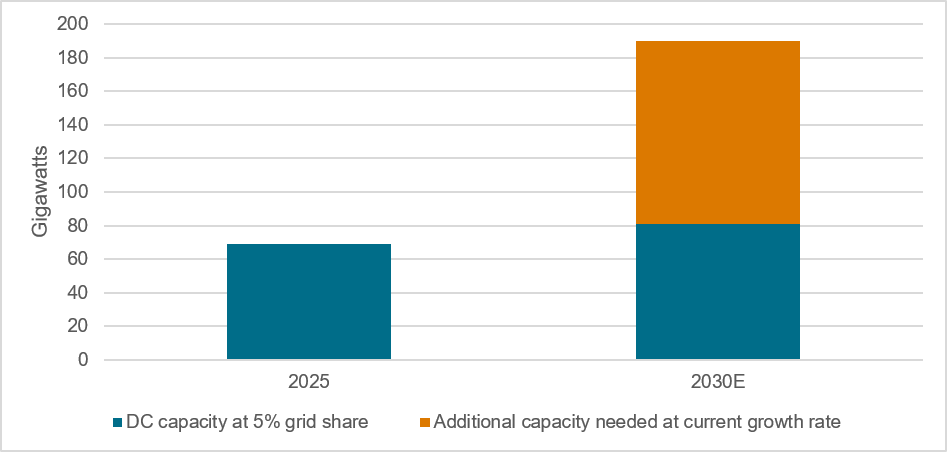
To mitigate the impact of long lead times for new grid connections, new US hyperscale data centres – the largest and most power-intensive facilities – are increasingly building their own sources of behind-the-meter (BTM) power generation. For data centres to maintain their 5% share of grid capacity, at current growth rates, they would need to source up to 58% of their power (110 gigawatts of capacity) from BTM sources by 2030, which is unlikely to be achievable. Data centres will meet their power demands through a combination of increasing grid share, moderated growth at power constrained sites and BTM sources.
Figure 2: Projected US data centre capacity needed at current growth rate vs grid capacity
(Source: Howden analysis of EIA data 451 Research by S&P Global)
Grid connection times are not the only power consideration. Howden's research also highlights the significant financial consequences of data centre outages, with half of facilities reporting an impactful incident over the past three years. Each outage costs an estimated US$500,000–US$1 million, implying global annual losses of approximately US$2 billion.
Power and back up failures, primarily involving uninterruptible power supply (UPS) systems, account for most major outages, followed by cooling failures, network failures, and IT system failures.
This presents an important protection/insurance gap. Many outages do not involve insured physical damage, meaning resulting financial losses may fall outside traditional property and business interruption policies. This is creating opportunities for innovative solutions, including parametric cover linked to service-level agreements and, where available, non-damage business interruption insurance.
Power constraints drive shift towards alternative energy sources
With new US power generation capacity often taking between 24 and 60 months to develop, data centre operators are increasingly exploring on-site generation to reduce their reliance on constrained electricity grids and accelerate development. This is driving investment in alternative, BTM power sources, including natural gas, renewables, battery storage and, over the longer term, nuclear energy.
Stuart Adam, Head of Natural Resources, Howden US, said: “Power availability is becoming one of the defining challenges of the data centre boom. As demand for AI infrastructure accelerates, developers are increasingly looking beyond traditional grid connections to secure the electricity they need.
“While on-site generation can help accelerate development and improve energy security, it also introduces new operational and financial exposures. As operators take greater responsibility for power infrastructure, understanding and managing these risks from the outset will be critical to protecting investments and avoiding costly disruption.
“The insurance industry has an important role to play, bringing together expertise across energy, construction and property to help developers manage these exposures and build more resilient infrastructure.”
Deborah Duss, Global Head of Advisory & Client Solutions, Global Specialty, Howden, said: “The data centre boom is shining a spotlight on an infrastructure challenge that has been building for years. While generation projects often benefit from faster development including permitting, grid infrastructure faces more complex project scopes, lengthy permitting, and multiple stakeholder interests, making it harder to keep pace with growing electricity demand.
For data centres, this makes location increasingly critical. A data centre, its power source and the grid infrastructure connecting the two cannot be considered in isolation. They are three interdependent parts of the same ecosystem and ultimately three key drivers of project success.
Taking a holistic view from the outset allows risks to be identified and managed before significant capital is committed, rather than trying to solve them once an asset is operational. Bringing those three elements together from pre-CAPEX planning through construction and across the OPEX lifecycle creates a more robust foundation for resilience, insurability, and long-term performance.”